Showing posts with label Iraq. Show all posts

Monday, June 21, 2010

unknown unknowns

From the NYT:
DAVID DUNNING: Donald Rumsfeld gave this speech about “unknown unknowns.” It goes something like this: “There are things we know we know about terrorism. There are things we know we don’t know. And there are things that are unknown unknowns. We don’t know that we don’t know.” He got a lot of grief for that. And I thought, “That’s the smartest and most modest thing I’ve heard in a year.”

Just to keep the record straight, people were laughing at Rumsfeld, because he only discovered "unknown unknowns" when it was completely self-serving to do so. There was nothing he didn't know before the Iraq war became an obvious disaster. Before the war, he told us that we knew Saddam had WMD, we knew he was a real threat to the U.S., we knew he was assisting Al Qaeda, and we knew that the war would be easy and over in a matter of weeks.

Rumsfeld dismissed anyone who doubted the wisdom of starting a second war while we were still fighting in Afghanistan. Not only did he ridicule them, he typically accused them of treason for giving 'aid and comfort' to the enemy.

Rumsfeld was neither smart nor modest in his answer. He was just attempting to deflect responsibility for his failures.

Thursday, November 6, 2008

Feingold as chair of the Foreign Relations Committee?

The Hill worries about the possibility that Russ Feingold could become chairman of the Senate Foreign Relations Committee.

That leaves Feingold, an unapologetic champion of civil liberties and a staunch opponent of the Bush administration’s war in Iraq, next in line. Feingold opposed the war from the start and was the first senator to call for a U.S. troop withdrawal timetable.

You'd think the results of the last two elections would make that a no-brainer. But not everyone agrees:

Democrats could bypass the Wisconsin senator and choose a more centrist member, such as Sen. Bill Nelson (Fla.), who initially supported the war and could be more open to compromise.

Yes. Why would anyone want a chairman who's an unapologetic defender of civil liberties and opposed an unpopular war, when we could have a man who reached across the aisle to vote for the biggest foreign policy blunder of the last 40 years?

I suppose in a bipartisan paradise Joe Lieberman would keep his committee chairmanship despite attacking the Democratic majority, and Russ Feingold would be expelled from the caucus for not playing nice with Republicans.

Wednesday, October 8, 2008

McCain: the challenge is to know when to go to war

McCain: [T]he challenge is to know when the United States of American can beneficially effect the outcome of a crisis, when to go in and when not, when American military power is worth the expenditure of our most precious treasure.

And that question can only be answered by someone with the knowledge and experience and the judgment, the judgment to know when our national security is not only at risk, but where the United States of America can make a difference in preventing genocide, in preventing the spread of terrorism, in doing the things that the United States has done, not always well, but we've done because we're a nation of good.

And I am convinced that my record, going back to my opposition from sending the Marines to Lebanon, to supporting our efforts in Kosovo and Bosnia and the first Gulf War, and my judgment, I think, is something that I'm -- a record that I'm willing to stand on.

Sen. Obama was wrong about Iraq and the surge. He was wrong about Russia when they committed aggression against Georgia. And in his short career, he does not understand our national security challenges.

Kosovo, Bosnia, the first Gulf war..... Isn't he forgetting something here?

For anyone keeping score - John McCain lobbied for a trillion dollar war that's turned into a quagmire. Barack Obama opposed it.

Friday, September 26, 2008

20 civilians a day are dying in Iraq

Documented civilian deaths due to violence in Iraq over the last 2 months. (Data from Iraq Body Count)

MCCAIN: This strategy has succeeded. And we are winning in Iraq. And we will come home with victory and with honor. And that withdrawal is the result of every counterinsurgency that succeeds.

And I want to tell you that now that we will succeed and our troops will come home, and not in defeat, that we will see a stable ally in the region and a fledgling democracy.

The consequences of defeat would have been increased Iranian influence. It would have been increase in sectarian violence. It would have been a wider war, which the United States of America might have had to come back.

So there was a lot at stake there. And thanks to this great general, David Petraeus, and the troops who serve under him, they have succeeded. And we are winning in Iraq, and we will come home. And we will come home as we have when we have won other wars and not in defeat.
Just to clarify; when John McCain insists that we are winning in Iraq, his definition of victory includes the fact that the capital city has been ethnically cleansed, neighborhoods are literally walled off from one another, one-fifth of the population of the country have fled their homes, corruption is rampant, Iran has extended it's influence into the highest levels of the government and, on average, only 20 people are being murdered every day.

Monday, July 28, 2008

Why won't Obama admit that the surge is working?

This may have something to do with it:
Female bombers struck Kurdish political protesters in Kirkuk and Shiite pilgrims in Baghdad on Monday morning, leaving at least 48 people dead and 249 wounded in one of the bloodiest sequences of attacks in Iraq this year.
One and a half years after the surge was implemented, Iraq remains one of the most violent places in the world. The surge only been a success compared to the bloodiest days of the conflict.

Thursday, May 22, 2008

In John McCain's world, the Iraq war began in May 2007

“Senator Obama has consistently offered his judgment on Iraq, and he has been consistently wrong. He said that General Petraeus’ new strategy would not reduce sectarian violence, but would worsen it. He was wrong. He said the dynamics in Iraq would not change as a result of the ’surge.’ He was wrong. One year ago, he voted to cut off all funds for our forces fighting extremists in Iraq. He was wrong…

...Why, if it had been up to Obama, we never would have gone to Iraq in the first place!


h/t Steve Benen

Monday, May 19, 2008

Sorry, he needs you to fight his forever-war

In John McCain's dream world, by 2013 the Iraq war has been won, bin Laden will be captured, and the soldiers who signed up after 9/11 still won't be eligible for benefits under his GI bill:
[Webb's bill] would increase education aid to all military members who've served on active duty since the Sept. 11, 2001, terrorist attacks. The House version has 294 co-sponsors; the Senate bill has 58.

McCain countered that the bill is misguided because it doesn't encourage soldiers to re-enlist.

Under the proposal, all veterans, including those who served in the National Guard or Reserve for at least 36 months since the attacks — not necessarily consecutively — could get full in-state tuition, regardless of cost, as well as some money for books, fees and a stipend for living expenses. Certain grants also could be provided for those who attend private colleges.

McCain, a former Navy pilot and Vietnam POW, has joined Sen. Lindsey Graham, R-S.C., and others to push an alternative that would make it easier to transfer education benefits to spouses and children and to provide more generous education benefits to personnel who serve for 12 years or more.

"This is not World War II we're fighting. This is not Vietnam," Graham said. "This is a global struggle with an all-volunteer force. And anything we can do to help retain people, I think, would be great."

True. This isn't World War II. World War II would have been over by now.


Monday, May 5, 2008

This election is all about the Iraq war

Fresh insight from a man who once suggested the Democratic race could end after the Iowa caucus:

DAN BALZ: I think the degree to which that it is a reminder that, in a long election, the terrain shifts. And, so, the ability to say, well, who is the best candidate in November when are you not entirely sure what that terrain may look like.

Eight or 10 months ago, there was so much talk about how the Iraq war would define, not only the general election, but also the outcome of the primary fight between Obama and Clinton. And now we have -- you know, it is not that Iraq is not unimportant. But, clearly, the economy and gasoline prices have risen considerably in terms of people's significance.


Newsflash: Barack Obama is winning the Democratic nomination because of the Iraq war. The Republican party is collapsing for the same reason.

Monday, April 14, 2008

Monday, April 7, 2008

Joe Lieberman: Still missing the point on the Iraq fiasco

Among all the other nonsense written by Iraq war cheerleaders Joe Lieberman and Lindsay Graham this jumped out at me:
In recent months, the Iraqi government, encouraged by our Ambassador in Iraq, Ryan Crocker, has passed benchmark legislation on such politically difficult issues as de-Baathification, amnesty, the budget and provincial elections.
See that's the funny thing, de-Baathification is what Paul Bremer did. Later, when even the Bush administration realized what a boneheaded move that was, they demanded that the supposedly sovereign Iraqis fix it. The "difficult issue" Lieberman is praising was de-de-Baathification.

But that would sound ridiculous.

Wednesday, March 26, 2008

John McCain defines success in Iraq

Give him some credit, it's more than George Bush has ever done:
Many people ask, how should we define success? Success in Iraq and Afghanistan is the establishment of peaceful, stable, prosperous, democratic states that pose no threat to neighbors and contribute to the defeat of terrorists. It is the triumph of religious tolerance over violent radicalism.
Of course the war in Iraq is currently a failure by all those standards.
Those who argue that our goals in Iraq are unachievable are wrong, just as they were wrong a year ago when they declared the war in Iraq already lost. Since June 2007 sectarian and ethnic violence in Iraq has been reduced by 90 percent. Overall civilian deaths have been reduced by more than 70 percent. Deaths of coalition forces have fallen by 70 percent. The dramatic reduction in violence has opened the way for a return to something approaching normal political and economic life for the average Iraqi.
Yes, compared to the worst days of the civil war - when death squads roamed the streets of Baghdad just miles from the Green Zone and millions fled their homes - things are now better in Iraq. This is about the only standard by which we're currently succeeding in Iraq.

John McCain doesn't compare Iraq today to Iraq 5 years ago because his war has made life worse in all respects. The progress he applauds is only relative to our previous failures and he insists the situation is so fragile that if we leave, there will be a genocide.

And as for life approaching normal, over 1000 Iraqis have died in political violence this March, which is up from February, which was up from January.

Update: make it about 1400 in March - nearly double January's toll.

Tuesday, March 25, 2008

Don't fight me in that there briar patch!

Br'er bin Laden suckers Farmer John, yet again...
"As you probably know, an audiotape ... was released where bin Laden said, and I have to quote bin Laden: 'The nearest field of jihad today to support our people in Palestine ... is the Iraqi field.' He urged Palestinians and people of Syria, Lebanon, Jordan and Saudi Arabia to 'help in support of their mujahideen brothers in Iraq which is the greatest opportunity and the biggest task.'"

McCain followed that with, "For the first time, I have seen Osama bin Laden and Gen. Petraeus in agreement, and that is, the central battleground in the battle against al-Qaeda is in Iraq today! That's what bin Laden is saying, and that's what Gen. Petraeus is saying, and that's what I'm saying, my friends."
Meanwhile, Osama is living a thousand miles away in Pakistan.

Sunday, March 23, 2008

Why did they get it right?*

Jim Henley explains why it was blindingly obvious that the Iraq war was a bad idea from the start:
You didn’t have to be all that bright to oppose the Iraq War in advance. Heck, polls suggest that most Americans were dubious about the idea until the war became obviously inevitable. Real enthusiasm was confined to the elite media, the bipartisan defense-policy establishment and a bunch of Republican quasi-intellectuals who had spent ten years casting about for different countries to have a war - any war - with. I mean, for crying out loud, at one point our rulers declared that Saddam Hussein might attack America with remote-controlled model planes. You didn’t have to wait to bounce that one off the folks at your next MENSA meeting to judge its likelihood. Nor did you have to puzzle overlong, if someone tried to put that one by you, how much stock you should put in anything else that came out of their mouths.
Typically, there is a single overriding reason to go to war. We went to war in Afghanistan because Al Qaeda had destroyed the World Trade Center and they were effectively the military arm of the Taliban. Everybody understood that and Americans overwhelmingly supported the decision to attack Afghanistan because of it. Freeing afghani women from oppression, bringing democracy to the country, ending their own brutal decades long civil war - those were all incidental to the cause and nobody argued they were casus belli in themselves.

On the other hand, we were given dozens of reasons to go to war against Iraq, some of them contradictory, some of them silly and some of them patently false. And when you know for a fact that any of the arguments for war are absurd, you don't need access to secret intelligence to realize that the rest of them are probably bogus too.

Of course, it wasn't easy to hear voices speaking against the Iraq war in 2002. Here's the Washington Post (in 2006), illustrating why.

The day after the House vote, The Washington Post recorded that 126 House Democrats voted against the final resolution. None was quoted giving a reason for his or her vote except for Rep. Joe Baca (Calif.), who said a military briefing had disclosed that U.S. soldiers did not have adequate protection against biological weapons.

"As a veteran, that's what hit me the hardest," he said.

Lee was described as giving a "fiery denunciation" of the administration's "rush to war," with only 14 colleagues in the House chamber to hear her. None of the reasons she gave to justify her concerns, nor those voiced by other Democratic opponents, was reported in the two Post stories about passage of the resolution that day.

So to acknowledge some of those who got it right from the start:

Scott Ritter (July 20, 2002):
I bear personal witness through seven years as a chief weapons inspector in Iraq for the United Nations to both the scope of Iraq's weapons of mass destruction programs and the effectiveness of the UN weapons inspectors in ultimately eliminating them.

While we were never able to provide 100 percent certainty regarding the disposition of Iraq's proscribed weaponry, we did ascertain a 90-95 percent level of verified disarmament. This figure takes into account the destruction or dismantling of every major factory associated with prohibited weapons manufacture, all significant items of production equipment, and the majority of the weapons and agent produced by Iraq.

In direct contrast to these findings, the Bush administration provides only speculation, failing to detail any factually based information to bolster its claims concerning Iraq's continued possession of or ongoing efforts to acquire weapons of mass destruction. To date no one has held the Bush administration accountable for its unwillingness - or inability - to provide such evidence.

Al Gore (Sept 23, 2002)

I am deeply concerned that the policy we are presently following with respect to Iraq has the potential to seriously damage our ability to win the war against terrorism and to weaken our ability to lead the world in this new century.

The vast majority of those who sponsored, planned and implemented the cold blooded murder of more than 3,000 Americans are still at large, still neither located nor apprehended, much less punished and neutralized. I do not believe that we should allow ourselves to be distracted from this urgent task simply because it is proving to be more difficult and lengthy than predicted. Great nations persevere and then prevail. They do not jump from one unfinished task to another.
Russ Feingold (Sept 25, 2002):
I remain extremely troubled by the Administration's shifting justifications for going to war in Iraq. I remain skeptical about the need to take unilateral action now and to accept all of the associated costs of that decision. I remain unconvinced that the Administration has thought through the potential costs and challenges of post-conflict reconstruction in Iraq, or even thought through how to address the issue of weapons of mass destruction once an engagement begins.
Shibley Telhami (Oct 7,2002):
One of the most appealing thoughts about a possible war with Iraq is that it could help spread democracy, transforming a rotten political order in the Middle East. But more likely, such a war would render the Middle East more repressive and unstable than it is today. Democracy cannot be imposed through military force, even if force is used successfully to oust antidemocratic dictators. And our vital aims in fighting terrorism, securing oil supplies and protecting the lives of American soldiers will, in the context of the Middle East, almost certainly ensure that the spread of democracy will again take a back seat to our national priorities.
Nancy Pelosi (Oct 10, 2002):
There is no political solution on the ground in Iraq. Let us not be fooled by that. So when we go in the occupation, which is now being called the liberation, could be interminable and the amount of money it costs could be unlimited - $100 -$200 billion, we can only guess.
Barack Obama (Nov. 25, 2002):

If (the invasion of Iraq and overthrow of Saddam) has happened, what the debate's really going to be about is; what's our long term commitment there? How much is it going to cost? What does it mean for us to rebuild Iraq? How do we stabilize and make sure that this country doesn't splinter into factions between the Shias and the Kurds and the Sunnis?

What I would have been concerned about was a carte blanche to the administration for a doctrine of pre-emptive strikes that I'm not sure sets a good precedent.

David Obey (Dec. 12, 2002):
The decision to prepare for military action against Iraq forces us to make difficult choices about the use of our assets, choices that further complicate our offensive against al Qaeda. Good military strategists and planners, for instance, are always in short supply, and when we do two things at once, they are very badly stretched. Our capacity to observe and listen for enemy activity through the skies and over the airways is finite. Our skilled Arabic translators are extremely limited in number. We have shortages in a number of specific types of equipment that are needed in both Afghanistan and Iraq. In short, our growing focus on Iraq will unquestionably degrade our efforts against al Qaeda and even official sources are already acknowledging those efforts are faltering. And if you doubt that one has an impact on the other, I invite you to talk to some of the people deep in the agencies who I've talked to.
*in response to Slate's series of a similar title

Wednesday, March 19, 2008

Was putting Muqtada al Sadr in control of Basra worth $600 billion?

5 years later:
"The successes we are seeing in Iraq are undeniable, yet some in Washington still call for retreat." - George W. Bush - explaining why Iraq "was worth it"

"Thirty years from now, when historians look back, where are they going to come out? If at the end of the day the U.S. screwed things up for four years and then in the end left Iraq a better place than they found it under Saddam, it may have still been worth it." - Iraq war advocate Ken Pollack

It is a great American myth, voiced by John Kerry last year, that the nation goes to war only when there is no question about the necessity of going to war. There's always a question. Even if the Iraqi insurgency disappeared tomorrow, George Ibrahim al Washington became president of Iraq and every liter of Saddam Hussein's onetime stockpile of chemical and biological weapons suddenly appeared in the desert, historians would still spend the next century debating whether the war was "worth it." - Robert Kagan (2005), arguing that not going in would have been even worse.

War is an expensive thing, but not the most expensive of things. A man unwilling to pay any price for the well-being of others is a sad creature indeed. - Tim Kane (2006) of the Heritage Foundation arguing "that the active American security umbrella enhances investment."

"If you look back on those five years it has been a difficult, challenging but nonetheless successful endeavor ... and it has been well worth the effort" - Dick Cheney, describing the phenomenal success that is Iraq
I'm not entirely sure which successes George Bush is talking about, but the number of times I've heard the the phrase "Iraq was worth it" going unchallenged is absurd. Bush and Cheney talk about fighting an enemy that didn't exist 5 years ago. People like Kagan, Pollack and Kane talk about a hypothetical Iraqi utopia, while the current standard of success is having fewer than 20 dead Iraqis a day.
Was redirecting American forces worth losing Osama bin Laden in the hills of Tora Bora?

Was crippling our military worth ethnically cleansing Baghdad?

Was chasing non-existent threats worth establishing Abu Ghraib?

Was defeating Iran's biggest rival worth putting ourselves in a 100-year quagmire?
Those of us against this war can rattle these questions off the top of our heads. But I've yet to see a pro-war advocate explain just what was worth it?

Tuesday, January 15, 2008

"Success" in Iraq: de-de-Baathification

The Iraqi Parliament has finally done something that the Bush administration, and many others, considered essential to political progress in Iraq: it passed a law intended to open government jobs to former members of Saddam Hussein’s Baath Party. What should have been heralded as an accomplishment, however, may only serve to further reinforce the bumbling nature of President Bush’s ill-conceived adventure in Iraq.
Let's remember that the only reason the Iraqis have to pass an anti-anti-Baathification law in the first place is to undo the anti-Baathification law originally passed by Paul Bremer with the blessing of the Bush administration.
In an act that many saw as the original sin that led to Iraq's current turmoil, Bremer crippled Iraq's institutions of governance and security and created half a million angry and jobless people in the process. He has since said that there were legitimate grievances about the order but that it was necessary to bring oppressed Shiite Muslims and ethnic Kurds into the government.

Bremer's order affected 400,000 members of the armed forces and all civil servants and officials above the Baath Party's lowest rank-and-file level, a number estimated at 32,000 to 85,000.
Bremer now blames the Iraqis for screwing up his brilliant plan.
We then turned over the implementation of this carefully focused policy to Iraq's politicians. I was wrong here. The Iraqi leaders, many of them resentful of the old Sunni regime, broadened the decree's impact far beyond our original design. That led to such unintended results as the firing of several thousand teachers for being Baath Party members. We eventually fixed those excesses, but I should have made implementation the job of a judicial body, not a political one.

Thursday, November 8, 2007

Barack Obama: America can’t engage in piecemeal diplomacy

Q. The Bush administration has little influence on Iranian behavior in Iraq. How would you elicit cooperation from Iran and Syria that the Bush administration has failed to obtain? Would we offer assurances that we would not be engaged in a policy of regime change. What would you do?

A. You’ve got the Bush administration expecting Crocker to make progress on the very narrow issue of helping Shia militias at the same time as you’ve got Dick Cheney giving a speech saying it is very likely that we may engage in military action in Iran and the United States Senate passing a resolution, suggesting that our force structure inside Iraq is dependent in someway on blunting Iranian influence. You can’t engage in diplomacy in isolation. There’s got to be a broader strategic context to it.

The Iranians and the Syrians are acting irresponsibly inside Iraq. They perceive that it is a way to leverage or impact or weaken us at a time when they’re worried about United States action in a broader context. I’ve already said, I would meet directly with Iranian leaders. I would meet directly with Syrian leaders. We would engage in a level of aggressive personal diplomacy in which a whole host of issues are on the table. We’re not looking at Iraq, just in isolation. Iran and Syria would start changing their behavior if they started seeing that they had some incentives to do so, but right now the only incentive that exists is our president suggesting that if you do what we tell you, we may not blow you up.

My belief about the regional powers in the Middle East is that they don’t respond well to that kind of bluster. They haven’t in the past, there’s no reason to think they will in the future. On the other hand, what we know, is that, for example, in the early days of our Afghanistan offensive, the Iranians we’re willing to cooperate when we had more open lines of dialogue and we were able to identify interests that were compatible with theirs.”

Barack Obama would withdraw from Iraq over 16 months

Q. Following that up, what is your schedule for withdrawing forces from Iraq? How fast would these withdrawals be carried out? What time frame?

A. [W]e believe that you can get one to two brigades out a month. At that pace, the forces would be out in approximately 16 months from the time that we began. That would be the time frame that I would be setting up. That also gives us time to make sure that we are strengthening the Iraqi forces. Obviously, I would prefer that we start this process now, but let’s assume that there are 100,000 troops when I get there, that means that we’re talking 14 to 15 months from now.


During that 16 months, I’m engaging in very systematic, tough diplomacy, not just with the various factions in the region, but also with Iran, with Syria, the Saudis, Jordan, with the United Nationals Security Council program members. Once it’s clear that we are not intending to stay there for 10 years or 20 years, all these parties have an interest in figuring out how do we adjust in a way that stabilizes the situation. They’re all going to have a series of complex differences and we’re going to, obviously, have to monitor it carefully about what those interests are to make sure our interests are protected. But what I don’t want to do is to make our withdrawal contingent on the Iraqi government doing the right thing because that empowers them to make strategic decisions that should be made by the president of the United States.”

Tuesday, October 30, 2007

Please stop helping


The bad idea that just refuses to die continues to gain support among the Washington elite, most recently in an article by ambassador Peter Galbraith, applauding Joe Biden's plan to divide Iraq into 3 parts.
In a surge of realism, the Senate has voted 75-23 to acknowledge that Iraq has broken up and cannot be put back together. The measure, co-sponsored by Joe Biden, a Democratic presidential candidate, and Sam Brownback, Republican of Kansas, supports a plan for Iraq to become a loose confederation of three regions -- a Kurdish area in the north, a Shiite region in the south and a Sunni enclave in the center -- with the national government in Baghdad having few powers other than to manage the equitable distribution of oil revenues.
This is all a very nice attempt to fix Iraq, presented by many of the same people who got us into this mess in the first place. All despite the stated desires of a majority of Iraqis to keep the country united, not to mention our own claim to have handed over sovereignty more than 3 years ago.

Having originally ignored the warnings that a preemptive war might descend into chaos, our Senators now feel quite proud that they've learned the difference between the Sunni, the Shia and the Kurds. Surely, the best solution is to separate each party and let them control their respective regions.

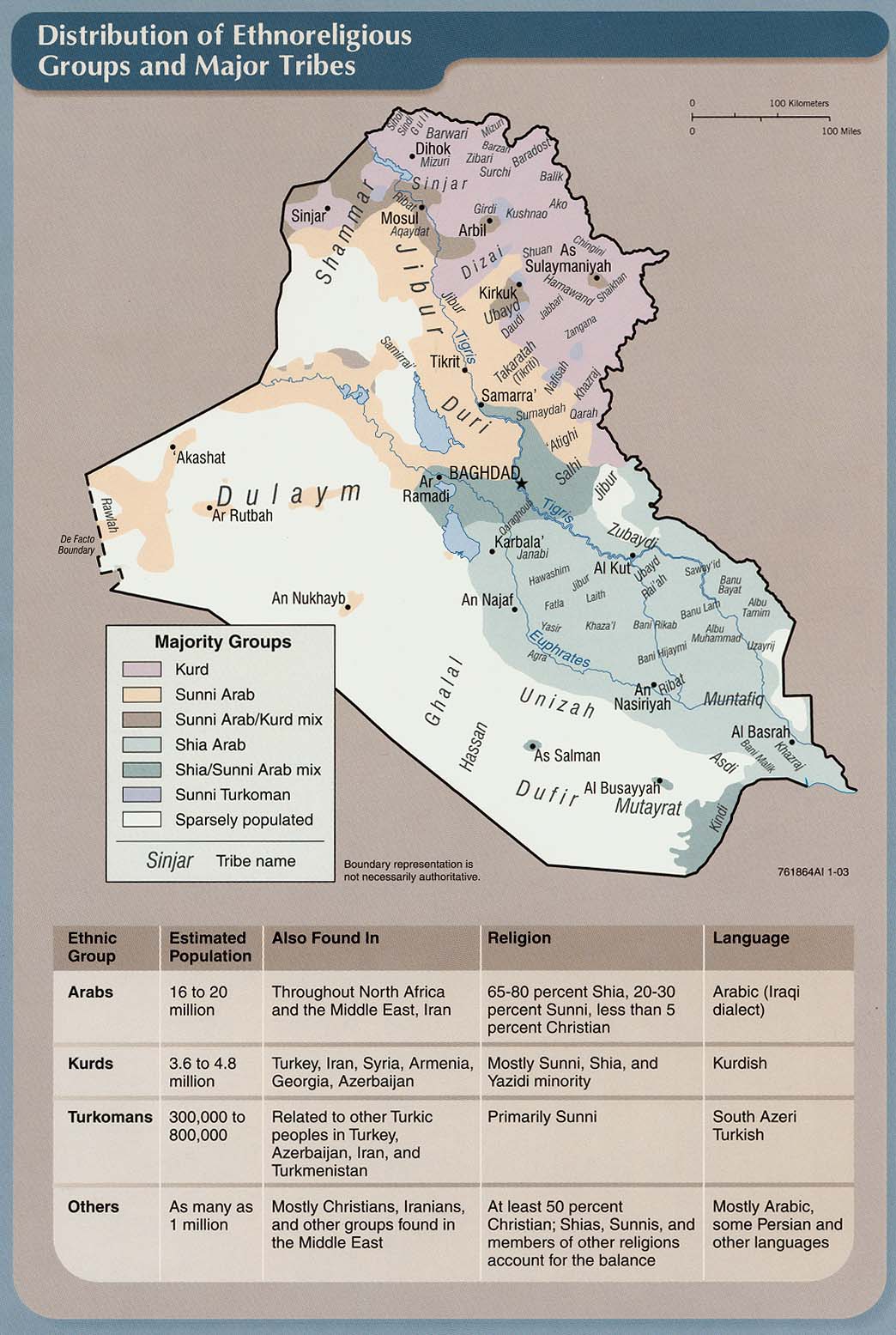
That is until you take a closer look at the map above and realize that the parties aren't as easy to separate as you might have hoped. The areas where the groups are mixed have names like Mosul, Arbil, Kirkuk, Sulayminiyah, Samara, Ramadi, and of course Baghdad. In other words, the places most of the people actually live.

Galbraith assures us that Iraq is unlikely to follow the Bosnian descent into ethnic cleansing and shrugs off the idea that the Turks might actually be serious about invading. But if you don't think the militias will do battle to seize control of the major cities then you haven't been paying attention.

Russ Feingold joined 22 Republicans opposing Biden's measure.
Barack Obama and John McCain were the only Senators not voting

Tuesday, October 23, 2007

You might have thought they'd have done that a while ago

Iraq ordered the closure yesterday of the Kurdistan Workers’ Party (PKK) offices in the country as pressure mounted on the Government of Nouri al-Maliki to clamp down on the hardline Kurdish separatists.

“The PKK is a terrorist organisation and we have taken a decision to shut down their offices and not allow them to operate on Iraqi soil,” Mr al-Maliki said after talks with Ali Babacan, the Turkish Foreign Minister.